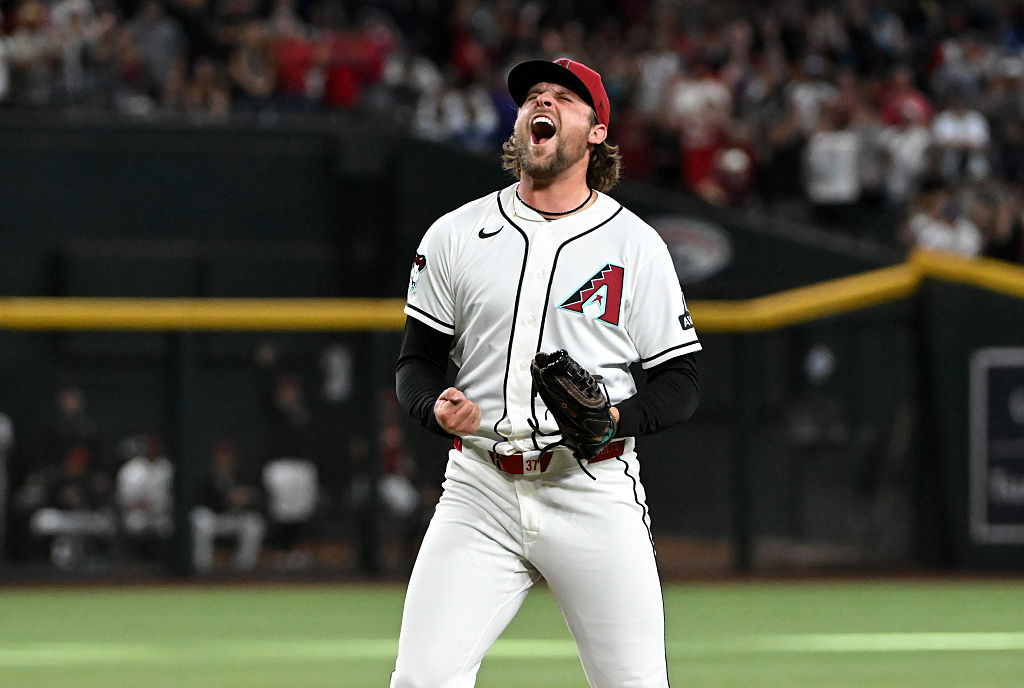
Reliever Roundup and Bullpen Bonanza: Diamondbacks Relief Unit Has Dominated Beginning of September
The Ketel Marte Soap Opera could have submarined the Arizona Diamondbacks’ season. They went 7–7 the rest of the month and, through the end of play September 9, had gone 12–11 (.522). That record is nothing to celebrate, but it could have been much, much worse. Their Pythagorean win percentage — what their win-loss record “should” be based on runs scored vs. runs allowed — is .399. That is third-worst in the NL, ahead of only the Colorado Rockies (.369) and Cincinnati Reds (.356). The difference between the Pythagorean and actual win percentage for the Diamondbacks is 123 points, the greatest positive difference in the NL. (Note: The Chicago Cubs have a Pythagorean win percentage of .574 and an actual win percentage of .391, a staggering difference of –183 points.)
Given that they are slashing .232/.301/.359 over that span, it is a miracle that they have won anything, let alone more than half their games. Their .232 batting average ranks 14th in the NL, and their .301 on-base percentage and .359 slugging percentage both rank 13th. Fangraphs has their weighted runs above average (wRAA) at –16.3, meaning their hitting performance puts them 16.3 runs below the NL average. Only the Washington Nationals (–16.4) and Atlanta Braves (–19.2) are lower.
However, eight of their games between August 16 and September 9 had a score difference of one run. The Diamondbacks won seven of them. Three more had a score difference of two runs. The Diamondbacks won two of those. Four of their games went to extra innings. The Diamondbacks won them all. For a team to go 9–2 in one- or two-run games and 4–0 in extra-inning games means their relief unit has been the true MVPs.
The Turning Point
On August 16, the Diamondbacks lost the third game of their three-gamer against the Braves, 5–3. That loss prevented them from sweeping the NL East leaders before heading to Boston for a three-gamer with the Red Sox. But that day was a turning point for the relief unit. For on that day, the Diamondbacks made a roster move that saw little fanfare. And given the saga that began the next day in Boston, it stayed under the radar. That roster move was the call-up of Dennis Santana.
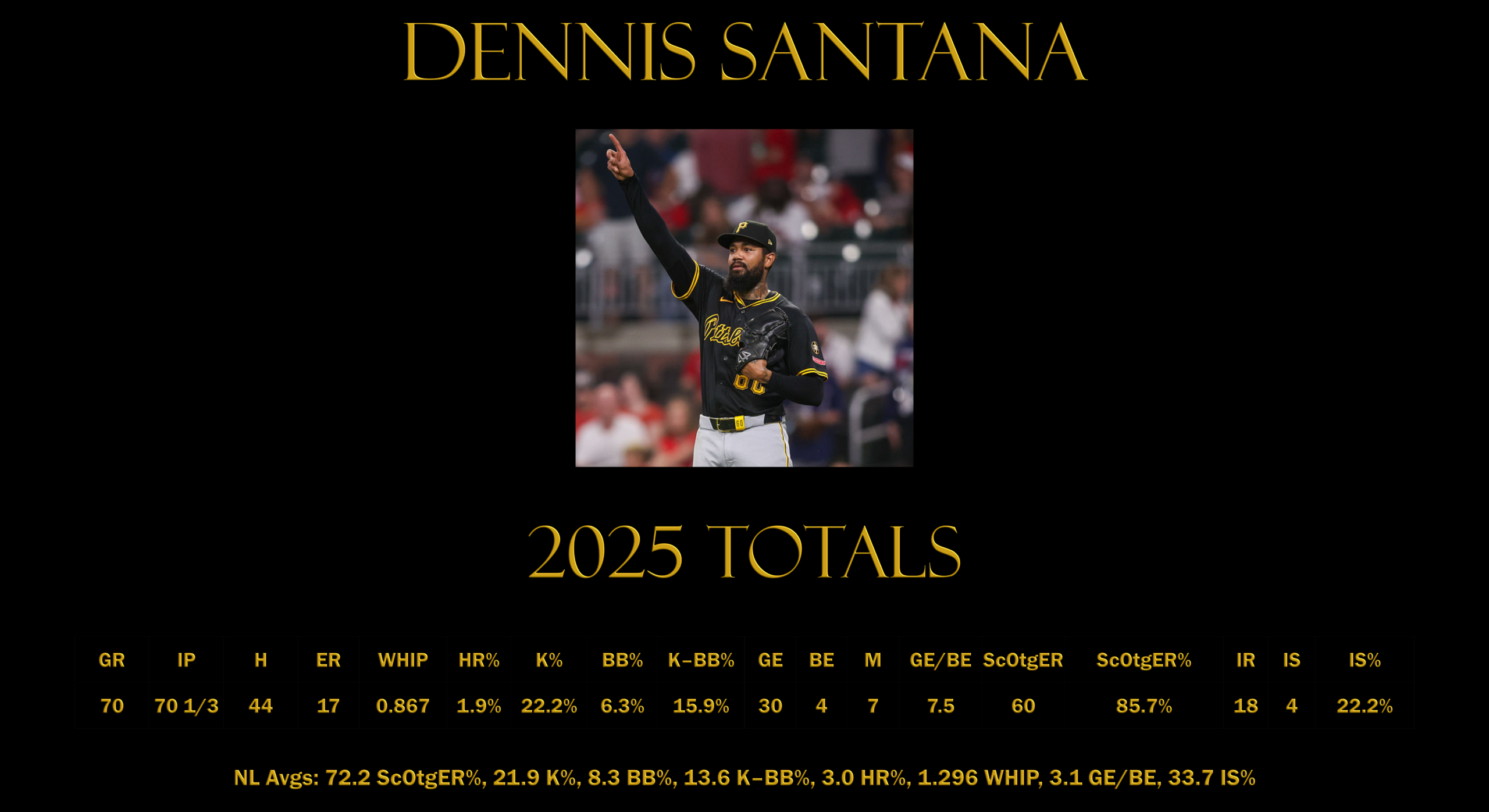
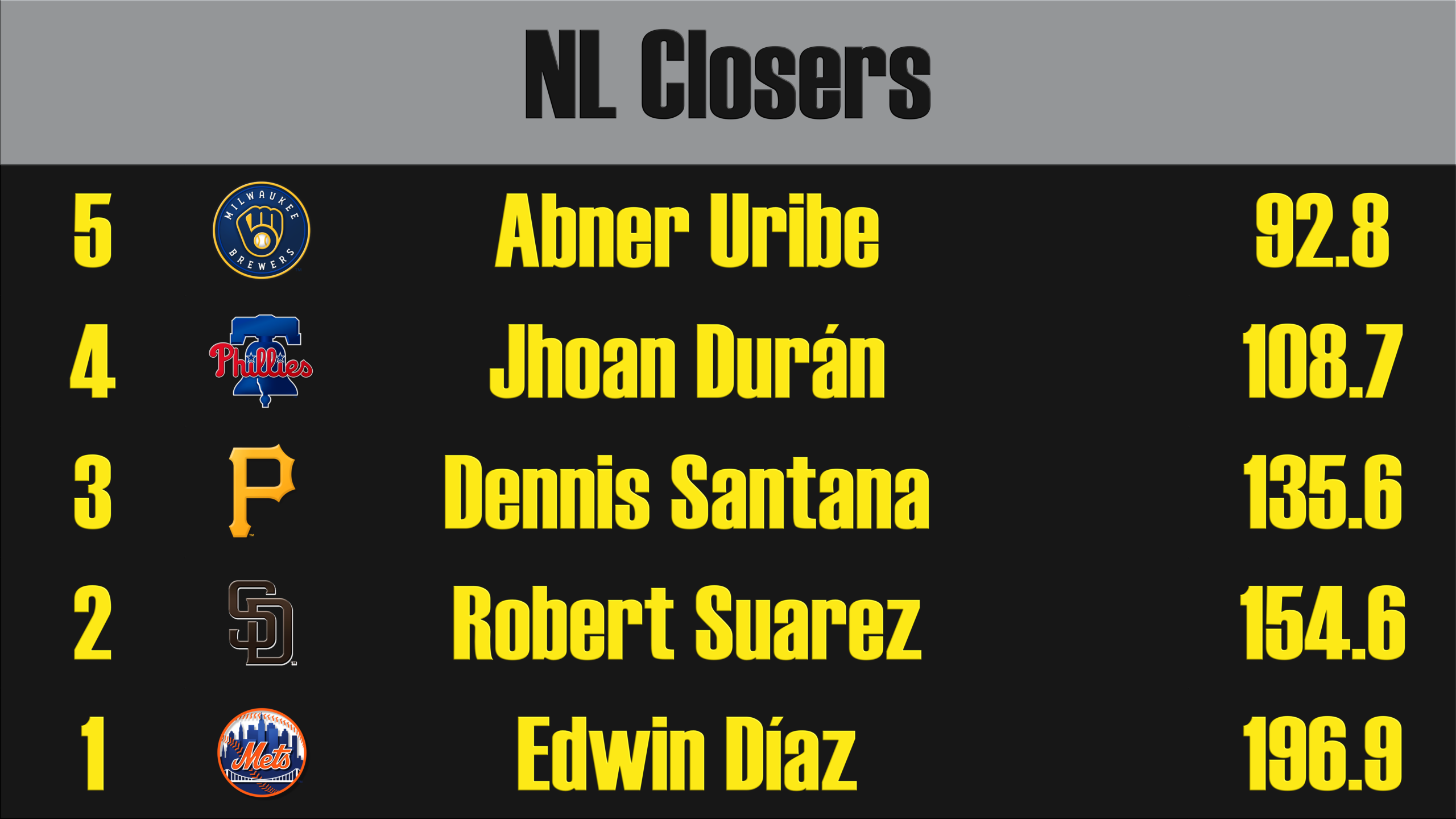
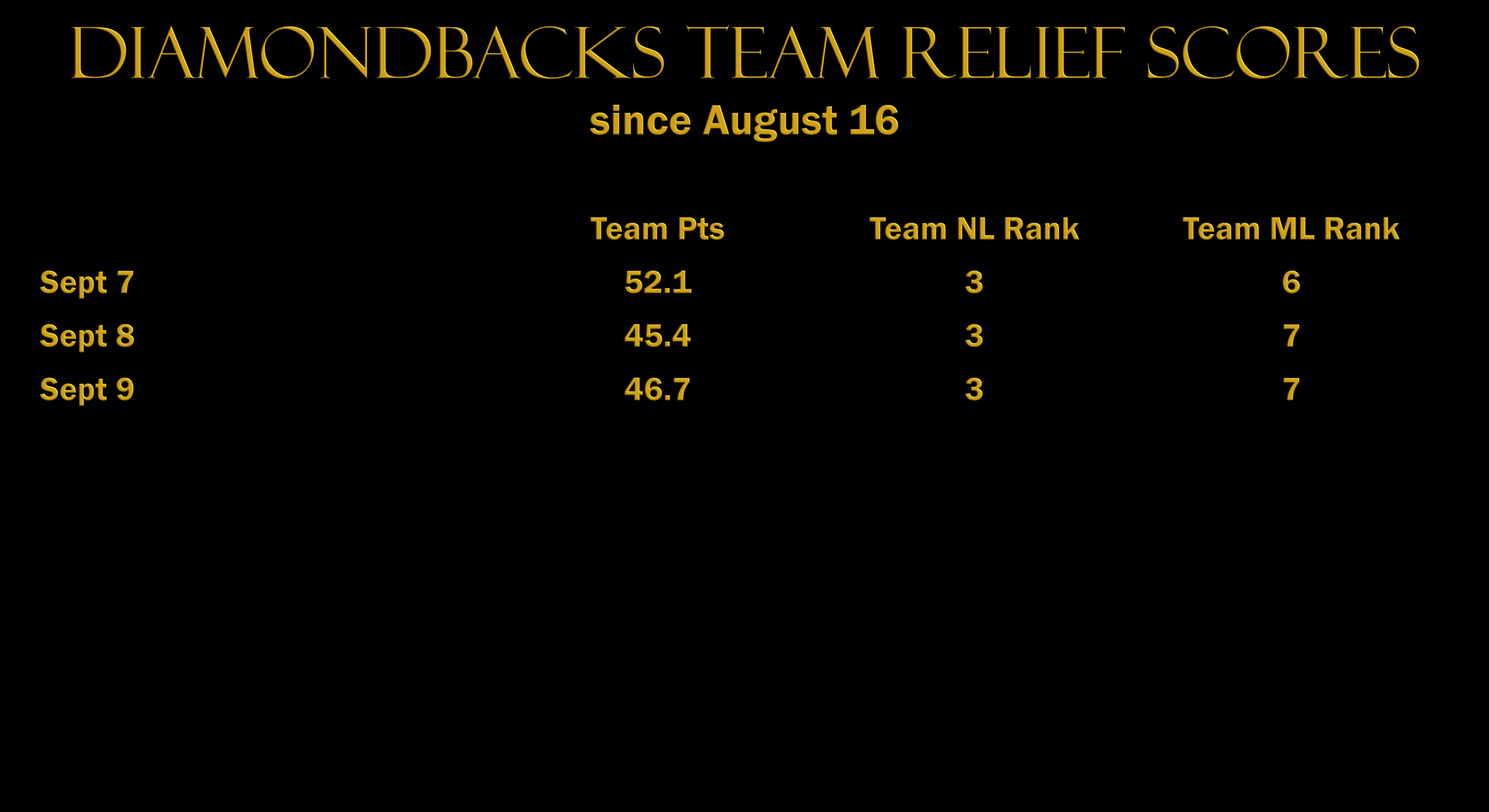
With 135.6 points, Santana finished 2025 as the #3 Closer in the National League on the Reliever Roundup & Bullpen Bonanza leaderboards. His 2025 performance with the Pittsburgh Pirates likely fed into why the Pirates were comfortable trading David Bednar. But Santana had a rough time in Pittsburgh in 2026 thanks largely to walks and home runs. They let him go in early August. The Diamondbacks signed him to a minor-league deal on August 5, two days after the Trade Deadline. After six days in rookie ball and two Triple-A appearances in Reno, the Diamondbacks called him up. From that day forward, the Diamondbacks relief unit has ranked third in the NL and seventh in the majors. (To the reader: At Reliever Roundup and Bullpen Bonanza, we always exclude position pitchers from the statistics we use. Therefore, the stats will probably differ from the relief pitching stats other sites list.)
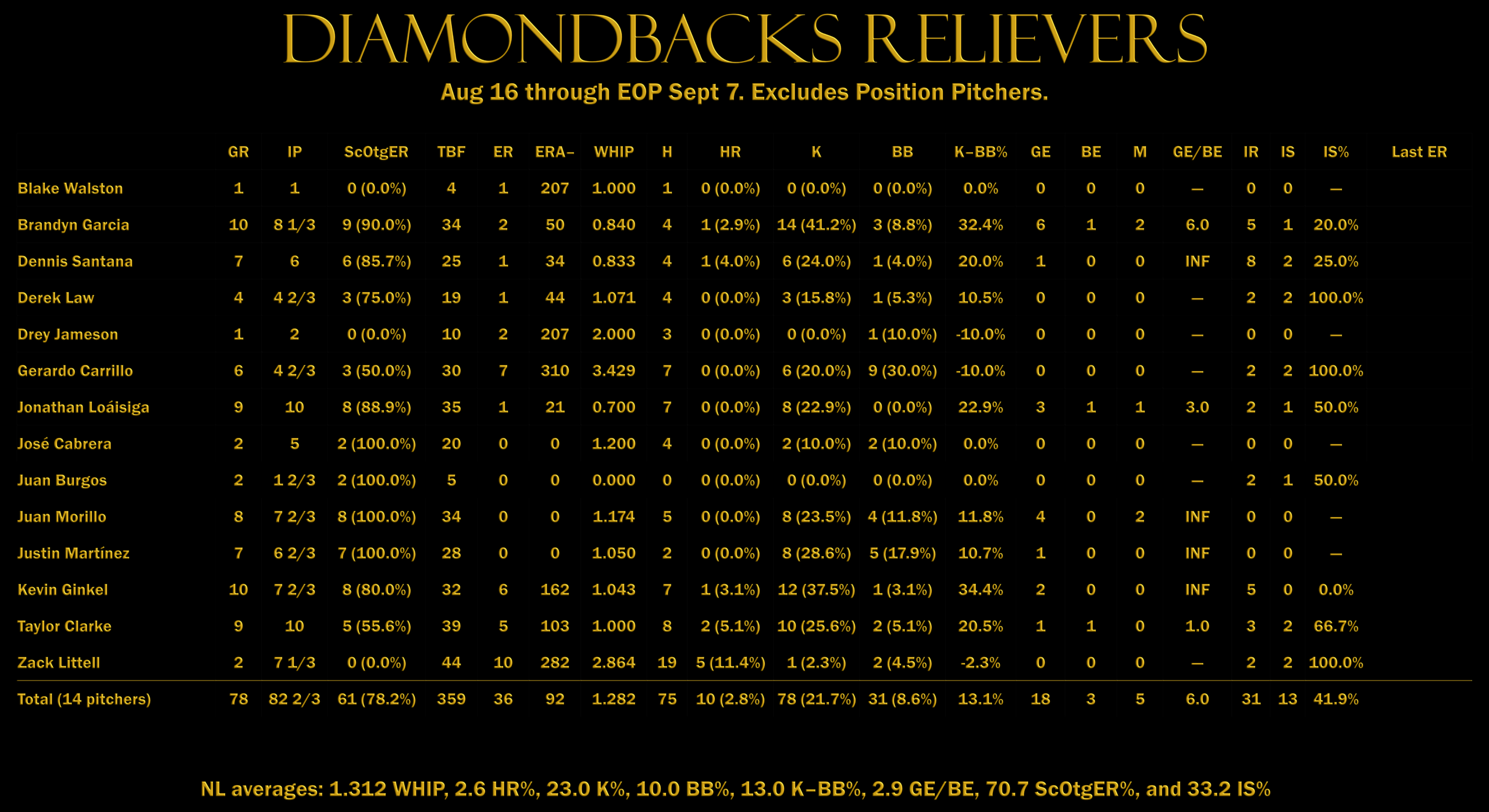
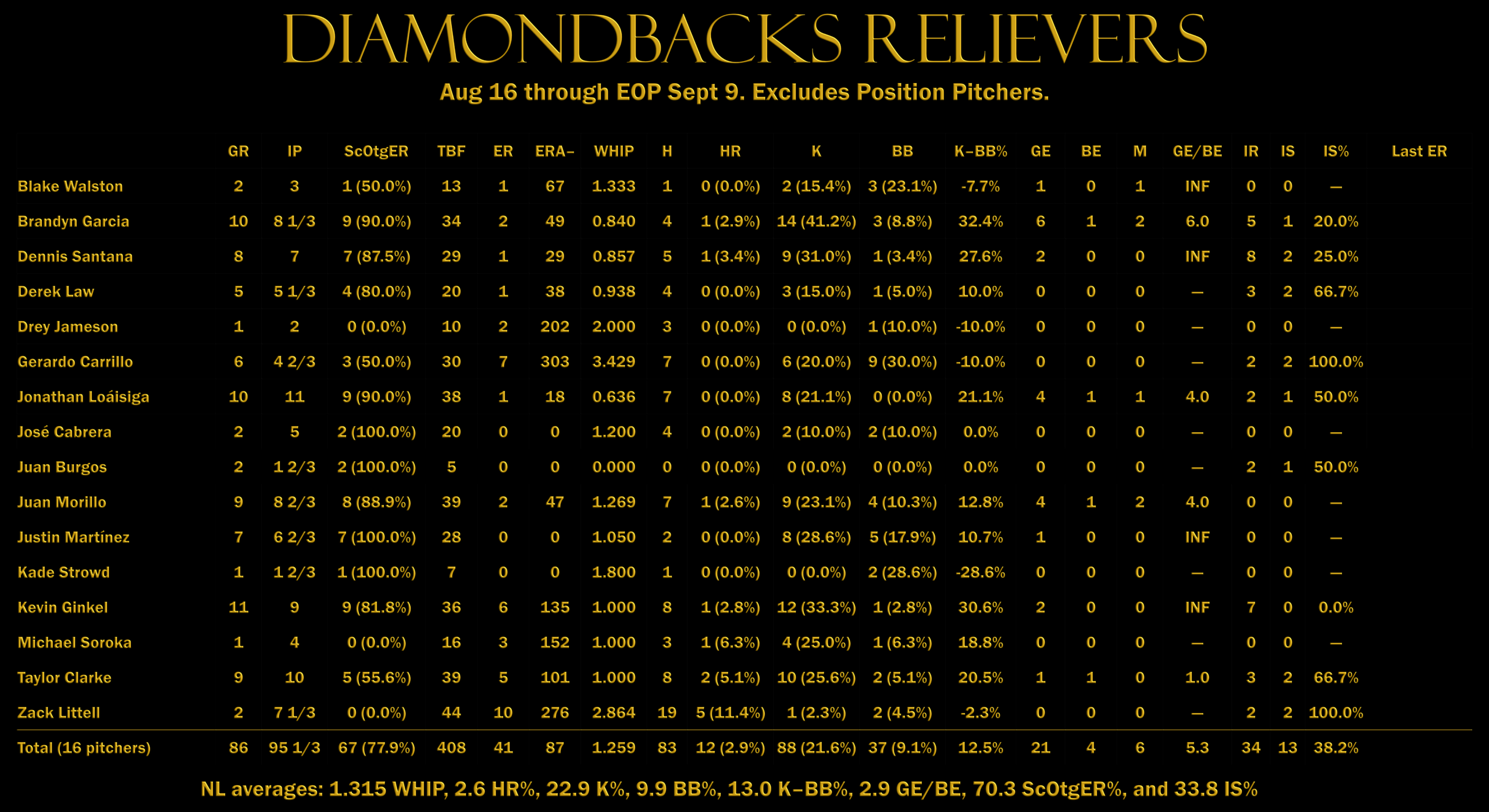
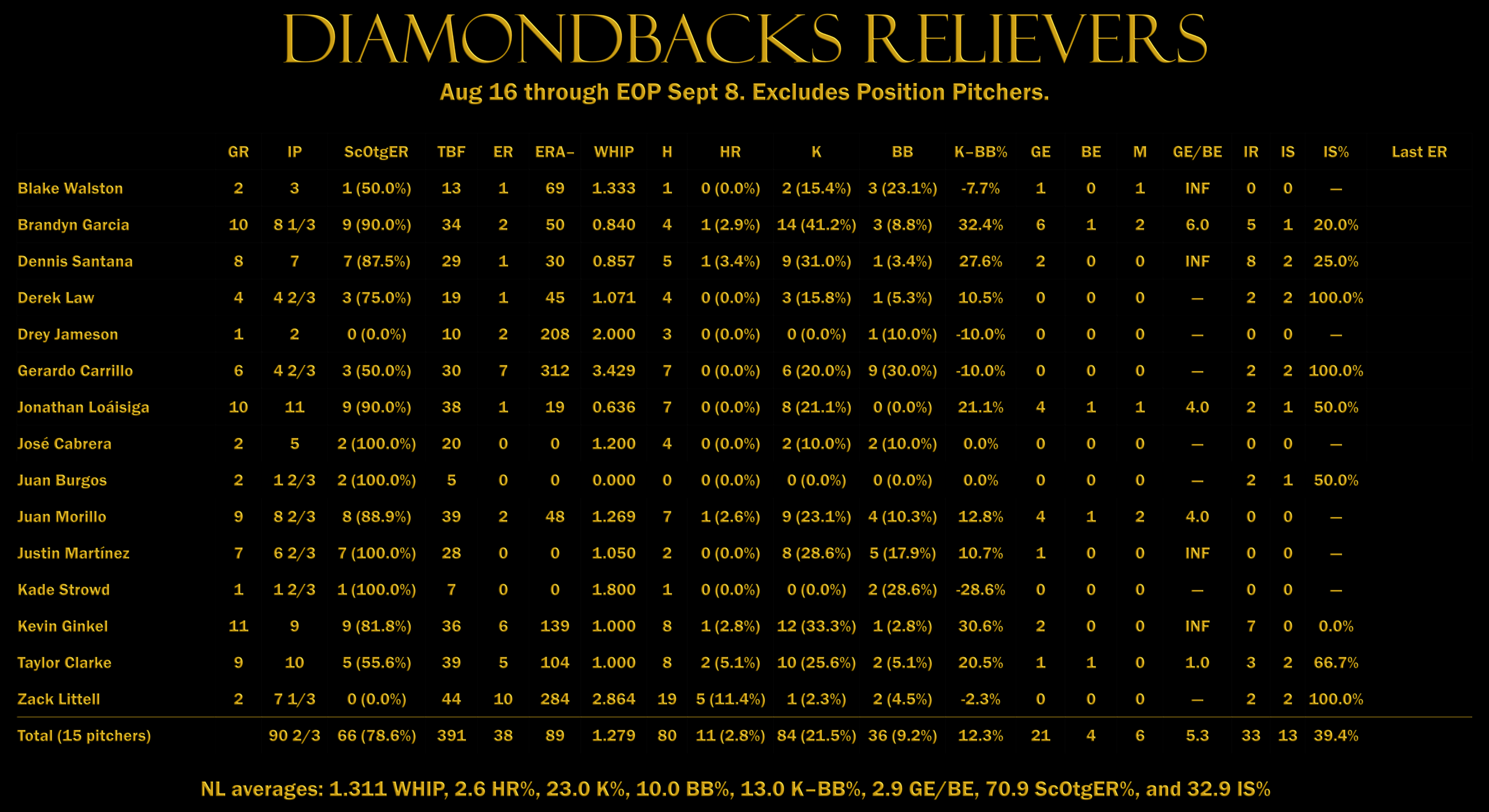
Here is the performance of every Diamondbacks reliever from August 16 through September 7, 8, and 9.
Making the Stats More Relevant
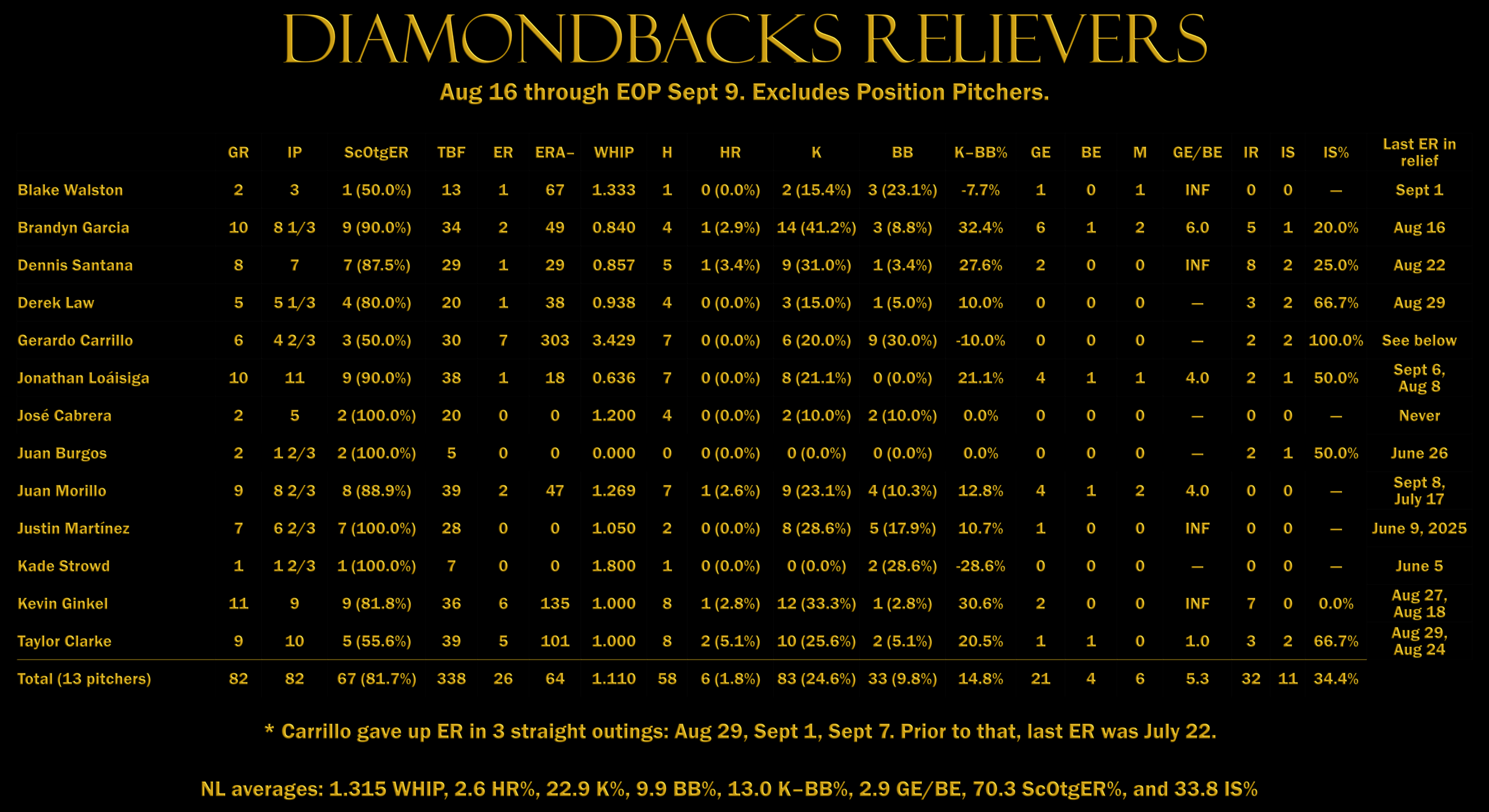
Zack Littell was a temporary long reliever the Diamondbacks picked up to fill a spot until Jameson came back from injury. As soon as Jameson did, the Diamondbacks let Littell go. However, Jameson had a nightmare return, and the Diamondbacks sent him back to Triple-A immediately. At that point, they brought up Jose Cabrera. Additionally, Soroka is in the rotation. His long-relief appearance came on the same day he and Zac Gallen returned from the injured list. Both had a lower-than-usual pitch limit, so Soroka pitched long relief after Gallen started, giving the main relievers a much-needed break. Given these factors, we’ll omit Littell, Jameson, and Soroka. Here is what that does.
Starting September on a Heater
(To the reader: The rest of the article might use some statistics you do might not recognize. To help you out, we have a glossary page. Furthermore, if a stat name is linked, click/tap it to see, in a new tab, the definition of that stat. Click/tap here to see the ranking method. Also, Juan Burgos got optioned August 26, so he does not appear in the September stat tables.)
For the first seven days of September, Diamondbacks relievers not named “Gerardo Carrillo” were on fire. In what this column calls “Goose Egg innings” — seventh inning or later, tie game or at most a two-run lead — the relief unit held opponents scoreless 12 out of 13 times. (These are called Goose Eggs.) That 13th time, Jonathan Loáisiga gave up an earned run against the Astros but did not lose the lead. (That is a Broken Egg.) And that was the first earned run Loáisiga allowed since August 8.
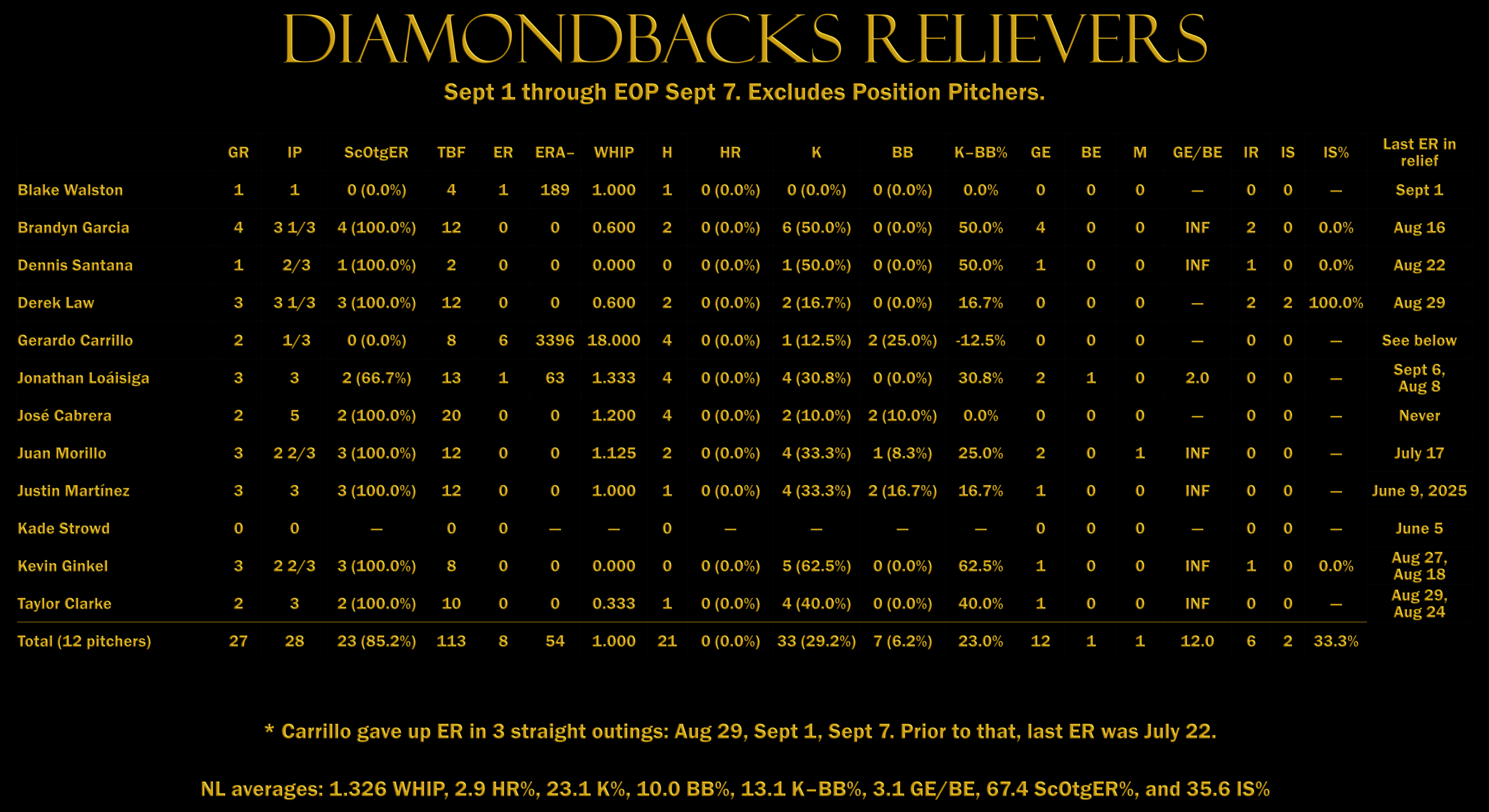
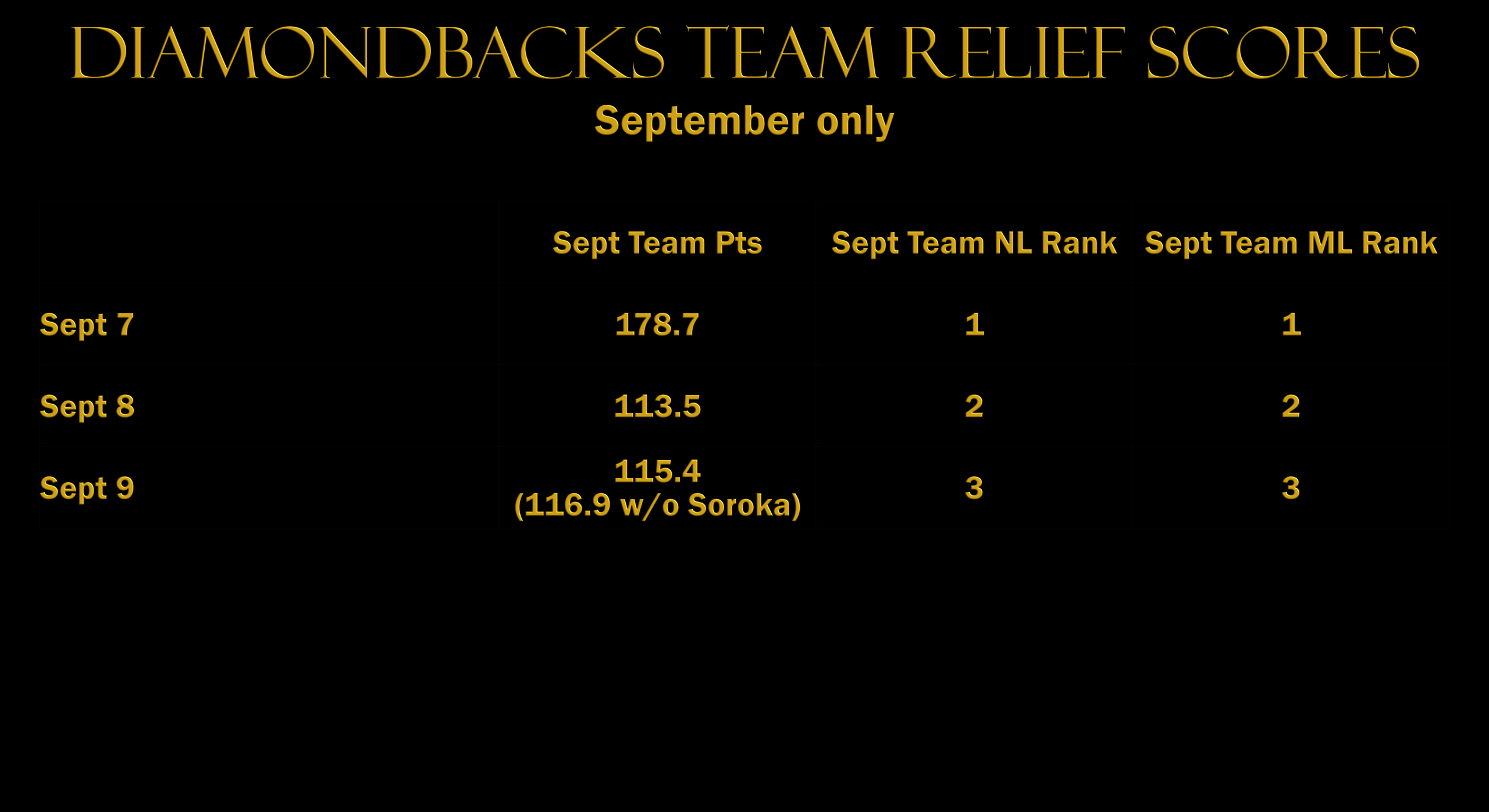
Even including Carrillo’s struggles, the relief unit as a whole had a WHIP of 1.000 (NL average: 1.326). Of their 27 total relief appearances, 23 were scoreless (if we only count earned runs) — 85.2%. Their K–BB% was 23.0%. That ScOtgER% was by far the best in the NL, well ahead of the second-place Padres (73.9%). Their WHIP (1.000) was second only to the Braves (0.940). They finished second in K–BB% over that span, trailing the Padres (23.4%). And keep in mind the Padres have strikeout machine Mason Miller (57.1 K–BB% from Sept 1–7) closing for them.
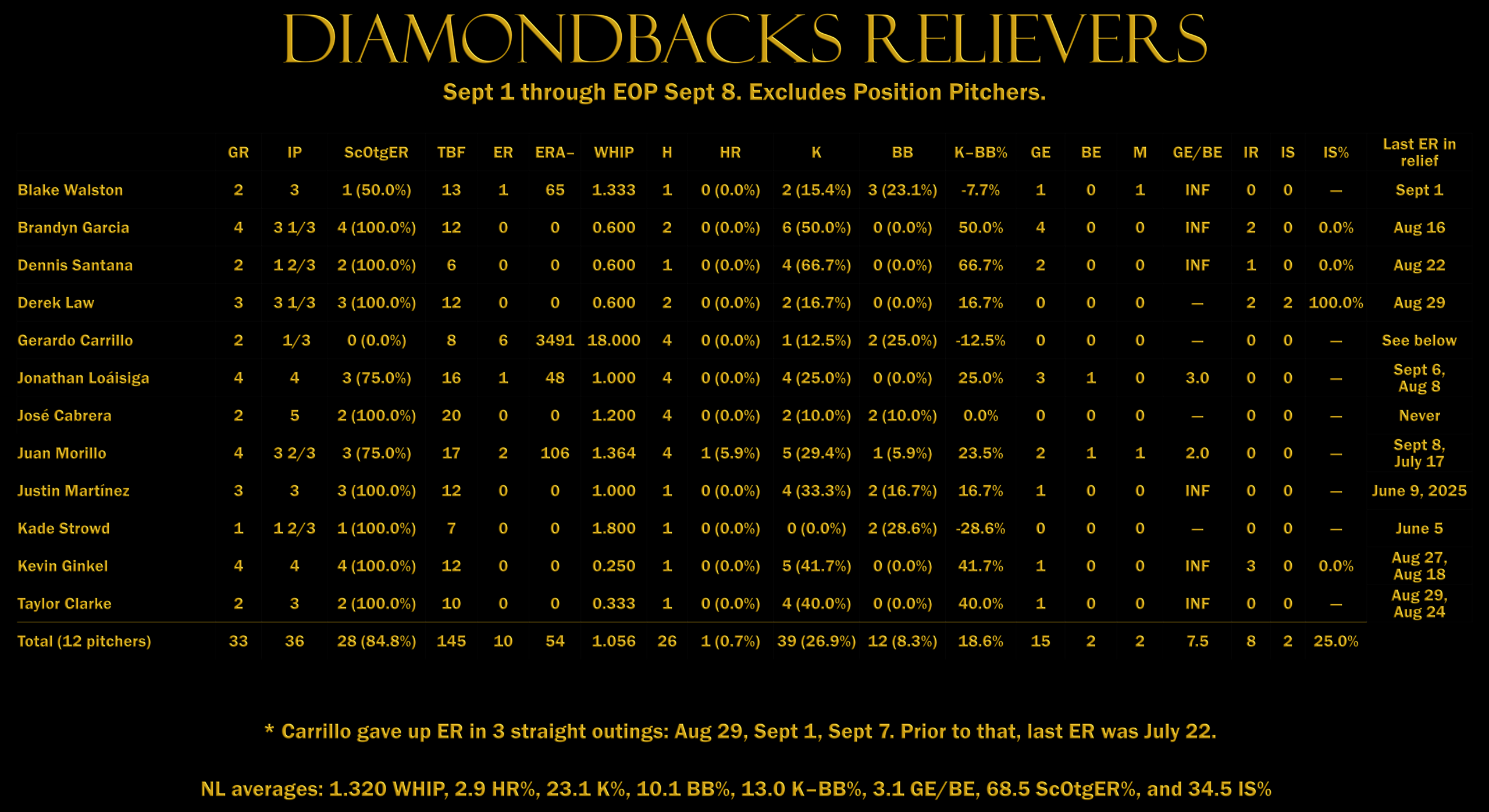
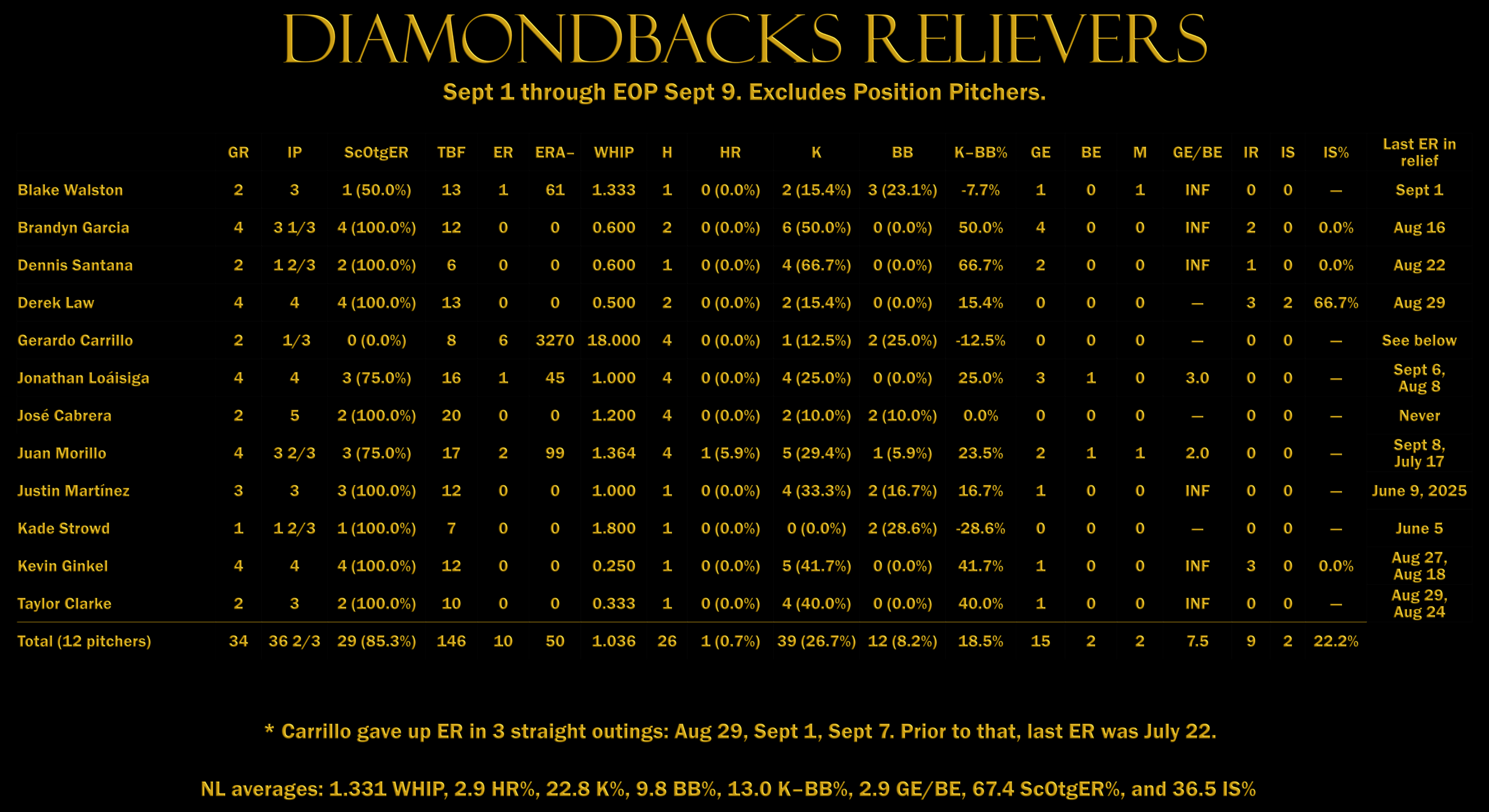
Even after the slight letdown on September 8 and Soroka’s long-relief appearance on September 9, the Diamondbacks remained in great shape. At the end of play September 9, they were third in the NL and seventh in the majors for the month of September. Both Broken Eggs came in games the Diamondbacks ultimately won anyway. Considering the starting rotation, during those eight games, only pitched 33 1/3 innings (last in the NL), that’s a heavy load for the relief corps. Per start, that’s around 4 1/3 innings.
Diamondbacks Relief Unit by Groups
Diamondbacks relievers who pitched during the first nine days of September — we aren’t counting Soroka — can be placed in four groups. These groups are Leverage Core, Middle-inning Group, Sent Down, and Lost His Mojo.
Leverage Core
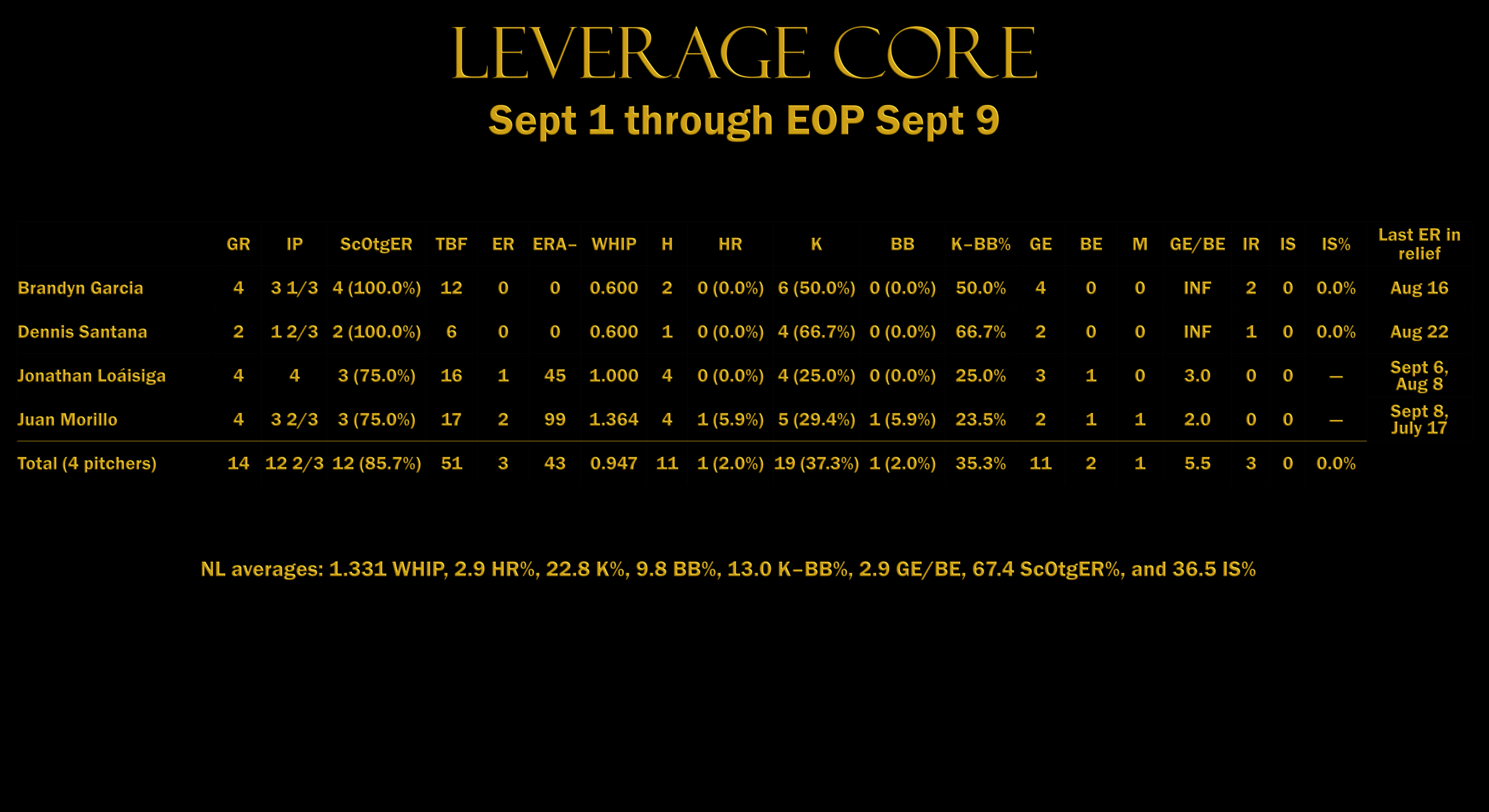
This group includes Brandyn Garcia, Dennis Santana, Jonathan Loáisiga, and Juan Morillo. The quartet combined for 14 relief appearances, allowing earned runs in two of them (85.7 ScOtgER%). As mentioned before, the Diamondbacks won those two games anyway. Additionally, that was the first time Loáisiga allowed an earned run since August 8 and Morillo allowed an earned run since July 17.
The leverage core combined to toss 11 Goose Eggs versus two Broken Eggs, a ratio of 5.5 GE/BE. They also had a 0.947 WHIP, 19 strikeouts (37.3%), one walk (2.0%), and a 35.3 K–BB%. Lastly, of the three runners they inherited, none scored.
Middle-inning Group
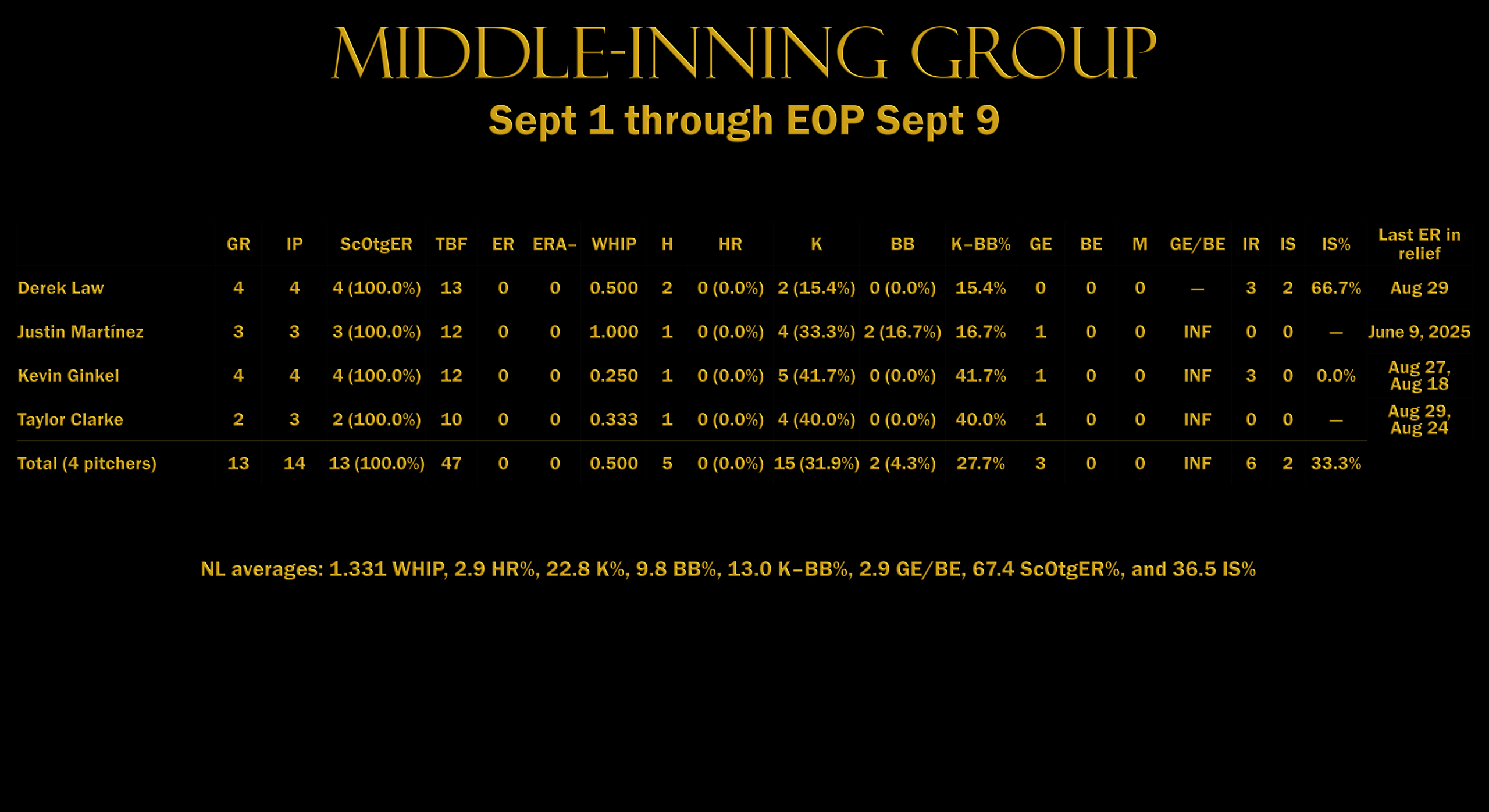
This group includes Derek Law, Justin Martínez, Kevin Ginkel, and Taylor Clarke. During the first nine days of September, they did not get charged with any earned runs over their 13 combined relief appearances. Their WHIP was a microscopic 0.500 after allowing five hits and walking two across 14 innings. Of the 47 batters they faced, they struck out 15 and walked two. This gave them a 31.9 K%, 4.3 BB%, and 27.7 K–BB%. Although they allowed two of their six inherited runners to score, their 33.3 IS% was lower than the NL average of 36.5%.
Sent Down
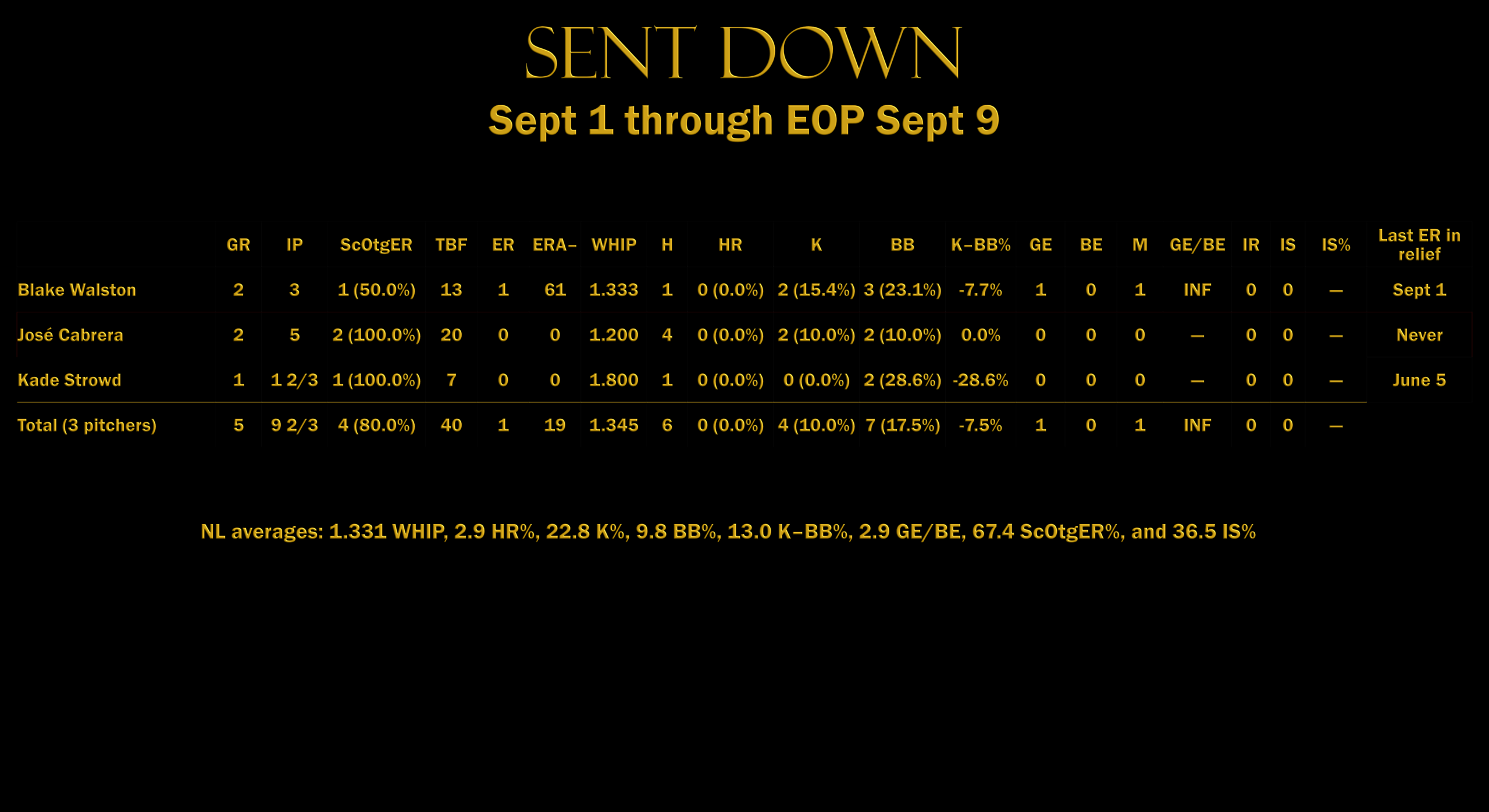
This trio includes Blake Walston, José Cabrera, and Kade Strowd. They combined for five relief appearances, holding opponents without an earned run in four (80.0 ScOtgER%). Though they ultimately did their jobs successfully — putting up zeroes every time on the mound — their K–BB% were areas of concern. Walston struck out two (15.4%) and walked three (23.1%) of the 13 batters he faced, marking a –7.7K–BB%. Cabrera faced 20 batters, striking out two and walking two. Strowd faced seven batters, walking two (28.6%) and striking out none (–28.6 K–BB%). Cabrera still had a good WHIP as a result (1.200), but Walston (1.333) and Strowd (1.800) were both above the NL average. Consequently, when guys started coming back from injuries, the Diamondbacks optioned Cabrera on September 8 and both Walston and Strowd on September 9.
Lost His Mojo

Another reliever was optioned September 8 due to losing his mojo — Gerardo Carrillo. For the first 28 days of August, Carrillo held opponents without an earned run in all seven relief appearances. He only allowed three hits and struck out 13 of the 42 batters he faced (31.0%). However, he also walked eight (19.0%), giving him a 11.9 K–BB%. His WHIP was still low — 1.065 — but the walk rate was a sign of impending danger.
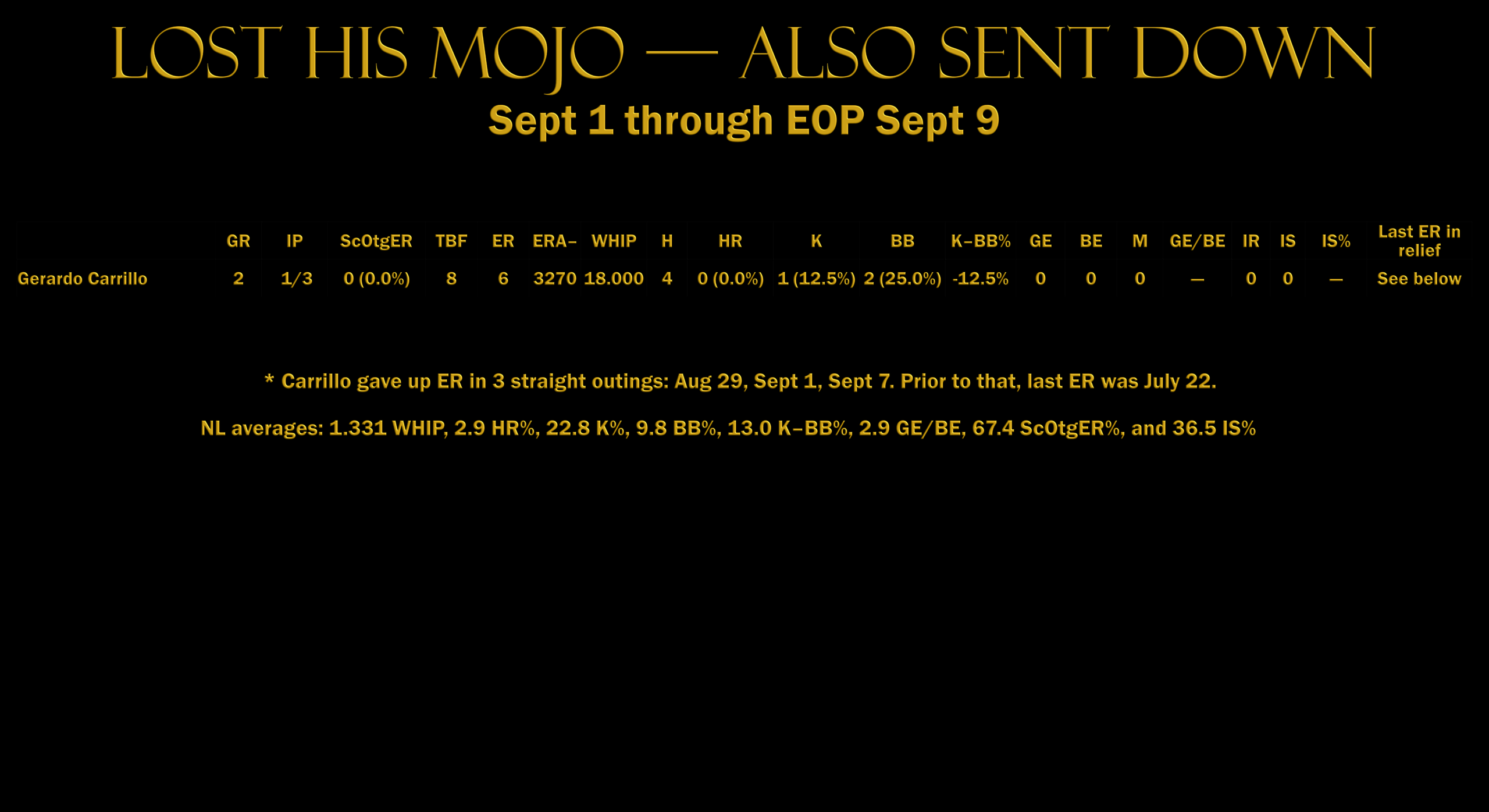
When the danger struck, it struck hard. He allowed two inherited runners and an earned run of his own to score August 29 after allowing two hits and walking two in 2/3 of an inning. On September 1, all three batters he faced reached base — two via hit and one via walk — and ultimately scored.
The Diamondbacks relegated him to mop-up duty at that point. His next appearance came September 7 with the Diamondbacks holding a 5–0 lead in the top of the 10th. Mop-up duty means pitching with a large lead or a large deficit. If it goes wrong and the team is already behind, the game was lost anyway so it doesn’t matter. But if the team is ahead, there is still time for a higher-leverage guy to come in and save the day. This is obviously not ideal, since it means that a guy they were hoping to rest suddenly had to pitch.
The other side of mop-up duty is this: another bad outing — two at the most — means the pitcher will either be optioned or designated for assignment. That is exactly what happened to Carrillo.
Looking Ahead
The Diamondbacks relief success continued September 11 against the Texas Rangers. Ginkel, Martinez, Clarke, and Santana combined for 4 2/3 innings of scoreless relief. They allowed three hits, walking one and striking out three. The Diamondbacks won, 9–1, to keep pace with the Padres and remain a half-game out of the NL’s third wild card spot.
Given the volatility relief pitching can bring, it is impossible to fully predict whether this run will continue. However, no matter what happens the rest of the season, this relief unit will go down as shouldering the burden during one of the most trying times in recent Diamondbacks history. For if not for the relief corps, the Diamondbacks would be out of the playoff picture already.