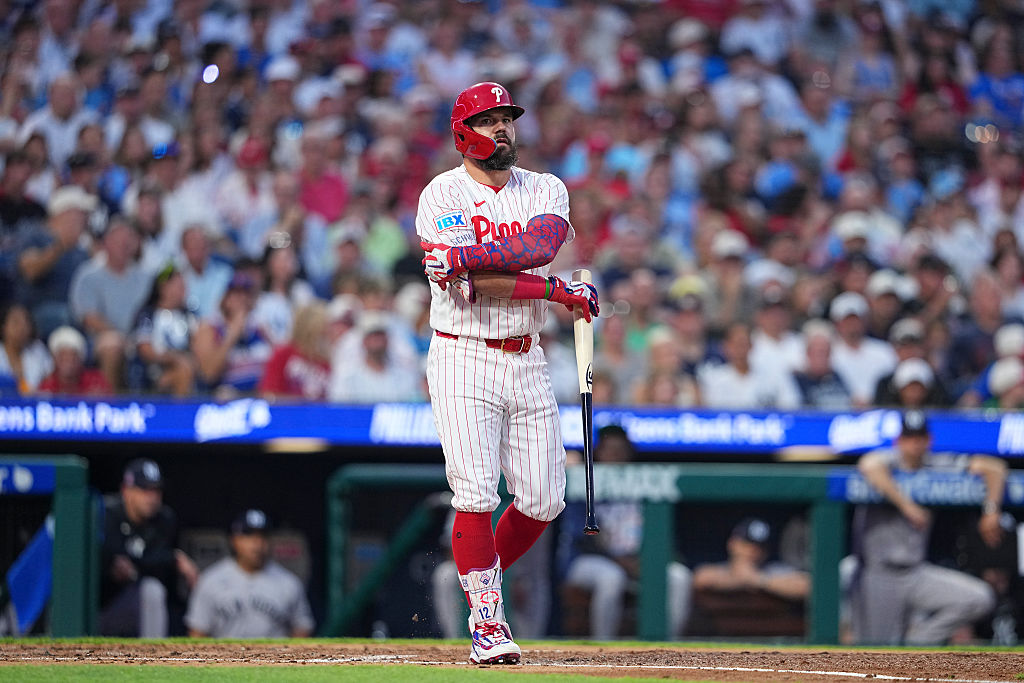
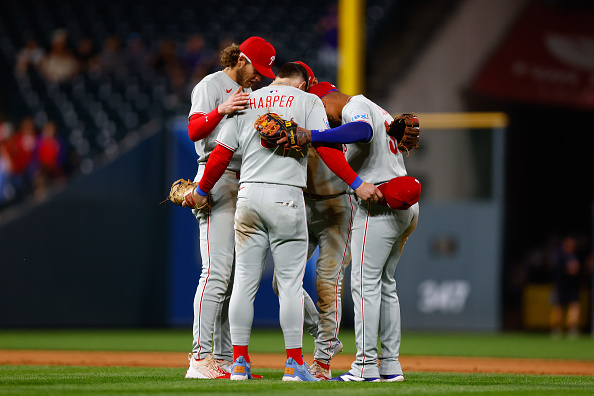
The early outlook on the infield of the 2026 Philadelphia Phillies shows a group driven by star power, positional flexibility, and a few analytical pressure points. Philadelphia leaned heavily on its infield during recent postseason runs, and the data show why. Run creation, durability, and defensive efficiency all flowed through this unit. As fans tracking every trend on the Phillies know, the question for 2026 centers on aging curves and how much upside remains.
Bryce Harper Anchors the Run Creation Core
Bryce Harper continues to redefine value at first base. After transitioning full-time to the position, Harper posted an on-base percentage north of four hundred while clearing thirty home runs in his most recent full season. His isolated power ranked among the league leaders for corner infielders, and his expected slugging closely matched actual output.
Defensively, Harper graded above average in scoops and reaction plays, which mattered for a staff that leaned on low walk rates. His presence stabilized both sides of the ball and allowed lineup flexibility that analytics departments value deeply.
Trea Turner Drives Variance at Shortstop
Trea Turner remains the most volatile piece of the infield from a numbers perspective. His sprint speed still ranks elite, and his base running added several runs above average. Turner’s strikeout rate dropped during the second half of the season, coinciding with a spike in line drive percentage.
Defensively, advanced metrics painted a mixed picture. Range remained strong while throwing accuracy fluctuated. The Phillies accepted that trade-off because Turner created offense in transition moments that swing win probability faster than most middle infielders.
Alec Bohm Brings Contact Stability at Third
Alec Bohm quietly delivered one of the most consistent offensive profiles on the roster. He posted a batting average near three hundred with runners in scoring position and ranked among team leaders in runs batted in totals.
From an analytics angle, Bohm thrives on contact quality rather than launch angle extremes. His hard hit rate stayed high while strikeouts remained controlled. Defensive metrics still lag behind elite third basemen, yet his reliability at the plate offsets that gap.
Second Base Is the Swing Spot
Second base carries the most uncertainty. Bryson Stott profiles as a high-floor option with on-base skills and strong positional instincts. His defensive runs saved ranked near the top tier at the position, and his walk rate supported lineup depth.
The concern involves power output. Without a jump in extra base hits, the position limits the overall infield ceiling. Development here shapes whether the unit grades as very good or elite.
Analytics Verdict for 2026
The 2026 Phillies’ infield projects as top ten in offensive value if health holds. Aging curves for Harper and Turner require careful workload management. Defensive efficiency depends on internal consistency rather than external upgrades.
Internal analytical breakdowns similar to those explored often highlight this balance between star-driven production and marginal gains. For 2026, Philadelphia owns the stars. The margins will decide how far they go.
More Philadelphia Phillies Articles
More MLB Articles
Main Photo:
Embed from Getty Images
- Category
-
Philadelphia Phillies