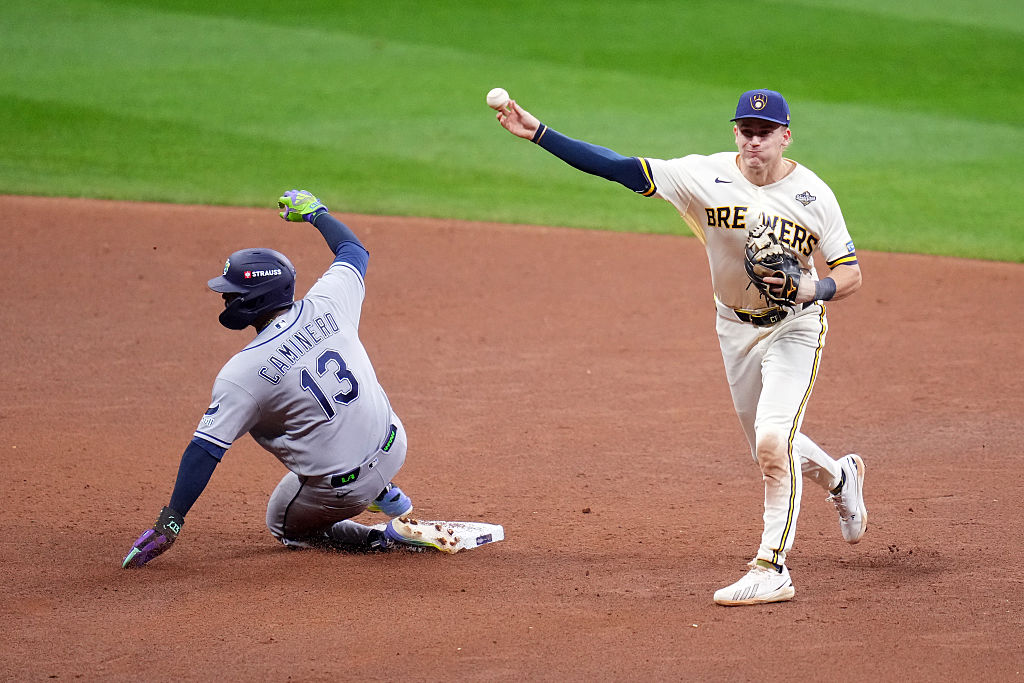
Brewers 3, Rays 2 — 2026 World Series Game One
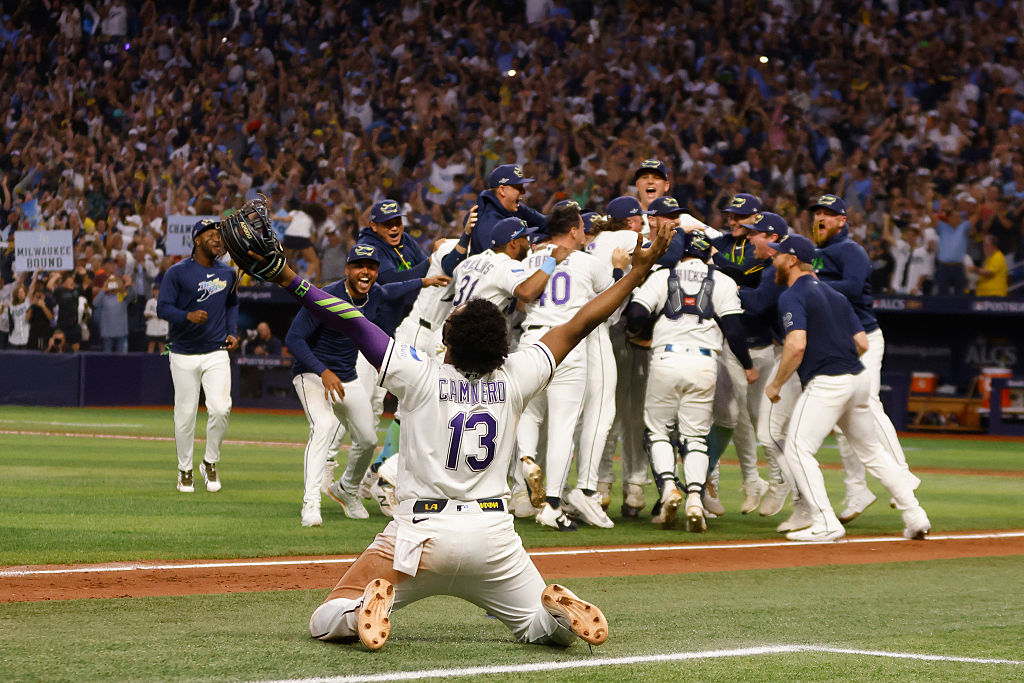
MILWAUKEE — The Milwaukee Brewers held on to defeat the Tampa Bay Rays, 3–2, in a tense Game One of the 2026 World Series.
Brewers starting pitcher Jacob Misiorowski outdueled Rays starter Nick Martinez in a homerless, low-scoring affair. But what made the game tense was the ninth, when the Brewers had to record the final out twice due to a (correct) replay overturn on an apparent double play.
Brewers – Rays Game Summary
The Brewers sent the already raucous sellout crowd of 43,250 to a higher plane when a one-out RBI triple from Christian Yelich off Rays starter Nick Martinez gave them a 1–0 lead in the bottom of the first. Rays center fielder Jonny DeLuca ran the liner down in right-center and dove, looking like a world-class soccer goalie diving for a lower-corner shot. He initially appeared to make a highlight-reel catch, but he could not hang onto the ball. It rolled away. Jackson Chourio, running from first, scored easily. William Contreras, up next, singled Yelich home. Martinez settled down and struck out the next two, ending the inning with the Brewers holding a 2–0 lead.
The Rays cut the lead to 2–1 in the top of the fourth. With one out, Liam Hicks, with runners on second and third, grounded to first with the pitcher covering. That scored Jonathan Aranda from third.
The lead grew to 3–1 in the bottom of the seventh. Cooper Pratt drew a leadoff walk off reliever Steven Matz. After he advanced to third on a one-out grounder to the shortstop, Kevin Kelly relieved Matz. Chourio welcomed him to the World Series with an RBI single to right.
Down to the Wire
The Rays did not go quietly in the ninth. Facing Brewers closer Trevor Megill, Jonathan Aranda and Chandler Simpson cracked consecutive one-out singles. After a successful double steal put them on second and third, Junior Caminero drew a walk to load the bases. Liam Hicks, up next, smashed a low two-hopper toward the hole on the right side. Brewers second baseman Brice Turang, ranging obliquely backward and to his left, gloved it. He pirouetted counterclockwise and fired to second. Cooper Pratt took the throw at the bag and fired to first in time to retire Hicks for a game-ending double play.
…but there was a challenge from Rays manager Kevin Cash regarding the play at second. Replays showed that Pratt pulled his foot off the bag slightly before catching the ball, making Caminero safe at second. With only one out being recorded, that meant pinch-runner Jorge Mateo scored from third. Additionally, Simpson was on third as the tying run, and Caminero was on second as the go-ahead run.
Jonny DeLuca came up next, and on 2–2, he swung at and missed a knuckle curve that dropped out of the zone. With that strikeout, the Brewers took the narrow victory and a 1–0 series lead.
What Went Right for the Brewers
The First Inning
The Brewers survived the top of the first unscathed, turning a line-drive double play with runners on first and second and one out. In the bottom half, Chourio opened with a single and scored on the Yelich triple. Yelich himself scored on the Contreras single one batter later. They turned a double play to avoid falling behind then immediately pulled ahead.
Shutdown Second and Third
Misiorowski threw a shutdown inning in the top of the second one half-inning after his team took the lead. It was the first of two straight 1-2-3 innings for Misiorowski.
Shutdown Middle Relief and Setup Work
Abner Uribe and Aaron Ashby combined for three scoreless innings from the sixth through the eighth. They collectively allowed one hit and struck out five, facing the minimum of nine hitters thanks to the strikeout-caught stealing double play.
Composure after Overturn
The challenge on the apparent Hicks double-play ball that would have ended the game led to an overturn, as mentioned already. But what Megill had to do there warrants mention. He thought the game was over at first. It is natural at that point to mentally let go. But with the call being overturned, he had to get refocused mentally and get another guy out. That is not easy to do.
But during the replay review, when the video played on the center-field jumbotron, Megill saw that Caminero was safe. That seemed to help him get refocused quickly. He explained, “We figured it out halfway through. You take a couple of deep breaths, look at the card, remind yourself whom you’ve got, and attack the zone again. I made good pitches there at the end.” But he knows this series is far from over, adding, “We’ve got a long way to go.”
What Went Wrong for the Brewers
The Ninth Inning
Even though they escaped, the Brewers did give up a run in the ninth to make the game 3–2. Furthermore, the tying run was on third and the go-ahead run was on second when the last out occurred.
What Went Right for the Rays
Aranda and Simpson
Jonathan Aranda, batting second, went 3-for-3 with a walk. He scored one of the two Rays runs, and the other came from Jorge Mateo, who pinch-ran for him in the ninth.
Chandler Simpson went 2-for-4 on the night and, representing the tying run, was standing on third when DeLuca struck out to end the game.
Starting Pitching
Nick Martinez allowed two runs on five hits, striking out five across five innings. Yes, the Rays lost, but Martinez kept them in the game. After allowing two runs in the first, he tossed four scoreless innings afterwards.
Cash called Martinez’s performance after the first inning “outstanding.” He later went into more detail. “Nick didn’t let the two runs early on factor into anything else once he went out for the second inning. Certainly gave us every opportunity. Kept it right there. I’m really impressed with and proud of the way Nick went about it.”
The Ninth Inning
The Rays rode two one-out singles, a double steal, and a walk to load the bases with one out in the top of the ninth. This put the tying run on second and go-ahead run on first with one out.
What Went Wrong for the Rays
Aggression Didn’t Work Out
Victor Mesa Jr. tried to steal third with two outs in the top of the fifth, but Contreras gunned him down for the third out. This came with Yandy Diaz batting and Misiorowski having thrown 22 pitches in the inning. Aranda was thrown out trying to steal second in the top of the sixth, finding himself on the back end of a strike-him-out, throw-him-out double play.
Cash did not have a problem with the decisions. Postgame, he said, “Ultimately Victor is really competing, trying to do something to make something happen, put a little pressure on the defense, and it didn’t work in our favor.” Regarding the Aranda play, Cash added, “That’s on me ultimately. So much trust in Chandler putting the ball in play. But he had a pretty nasty pitch. It looked like down and in, check, swung.”
Granted, the ninth was the one time the baserunning aggression didn’t fail, as Simpson and Mateo pulled off a successful double steal of second and third, respectively. This put the tying run in scoring position. However, the two times the aggression failed greatly hurt the Rays.
Couldn’t Get the Big Hit
The Rays batted 0-for-6 with runners in scoring position. Three of their four runners left on base were in scoring position — Junior Caminero was left stranded on third in the fourth, and the tying and go-ahead runs were left on third and second, respectively, in the ninth.
Atom Ball in First
The inning where they left a runner on base but none in scoring position was the first. However, the way the inning ended had the same effect as if they did. In the first, the Rays had Jonathan Aranda on second and Chandler Simpson on first after a pair of one-out singles. Caminero smashed a liner to the left side. It went directly to Brewers third baseman David Hamilton, who caught it. Aranda had absolutely no chance to get back in time to prevent a double play, which the Brewers easily turned. Hamilton fired to second baseman Brice Turang, who stepped on the bag for the third out.
DeLuca Couldn’t Hang On
This is not DeLuca’s fault by any means, so this is more about the result than the action. We try to avoid this at Sport Relay, since results aren’t always fully in the player’s control. However, it is worth pointing out that DeLuca not hanging on when he dove and appeared to catch Yelich’s deep line drive in the first led directly to one run and indirectly to a second. When the ball trickled away, Chourio scored without any trouble and Yelich made it to third easily with a triple. The follow-up single by Contreras plated Yelich.
Quotes
“We want to get it right, man. We’ll be doing the checked swing there later on. The obstruction play will be replayed. MLB makes rule changes for the better. They just do. Then things happen, and then they make another adjustment and another adjustment. Let’s get it right. Let’s not call the neighborhood play. What is the neighborhood? How big is your neighborhood? I think they got it right. Even if we gave up two runs there and we lose the game and we’re sitting here and we’re all dejected, the rule is put in place for the right reason, to get it right. I don’t know if they got it right. I’m assuming they did. There’s a lot of people that have better vision than I.” — Brewers manager Pat Murphy on the ninth-inning replay overturn
Quick Hits
The first pitch of the game was a 103.5-mph Jacob Misiorowski fastball. That broke the record for fastest first pitch ever thrown in a World Series game. It surpassed the 103.2-mph fastball Aroldis Chapman of the Chicago Cubs threw to open Game Two of the 2016 World Series.
Prior to Christian Yelich, the last player to hit an RBI triple in his first career World Series start was Curt Flood of the St. Louis Cardinals. This happened in Game One of the 1964 World Series off Al Downing of the New York Yankees. (H/t: Jayson Stark of The Athletic) Downing later became the answer to a trivia question when he gave up Hank Aaron’s 715th home run on April 8, 1974, which surpassed Babe Ruth to give Aaron the career record that he held for 33 years.
The first-ever World Series ABS challenge came from the Brewers in the top of the second. Contreras challenged a ball call with Victor Mesa Jr.batting. It would have been ball one but turned out to be a strike. Misiorowski struck Mesa out swinging on the next pitch, ending a 1-2-3 inning.
Chourio and Contreras were the first Brewers with multiple hits in a World Series game since the last World Series game the Brewers played in prior to Friday night. That was Game Seven of the 1982 World Series, when Hall of Famer Paul Molitor went 2-for-4 against the Cardinals.
Megill became the second Brewer to ever record a save in a World Series game. The first was Bob McClure, who notched two in the 1982 World Series due to the injury to Hall-of-Fame closer Rollie Fingers. When asked if he had even heard of Bob McClure, Megill admitted he had not.
Looking Ahead
Misiorowski earned the win as Martinez took the tough loss. Megill notched the save, his fifth of this postseason. Misiorowski is the first Brewers starting pitcher with a win during the 2026 postseason. Megill is the first pitcher with five saves in a single postseason since Paul Sewald of the Arizona Diamondbacks tallied six during their 2023 World Series run.
The Brewers and Rays will meet for Game Two Saturday night in Milwaukee. Rookie Logan Henderson (11–3, 2.47 ERA in regular season) will start for the Brewers against Drew Rasmussen of the Rays (16–5, 2.67 ERA) in a battle of right-handers. First pitch from American Family Field will be at 7 pm Central/8 pm Eastern.