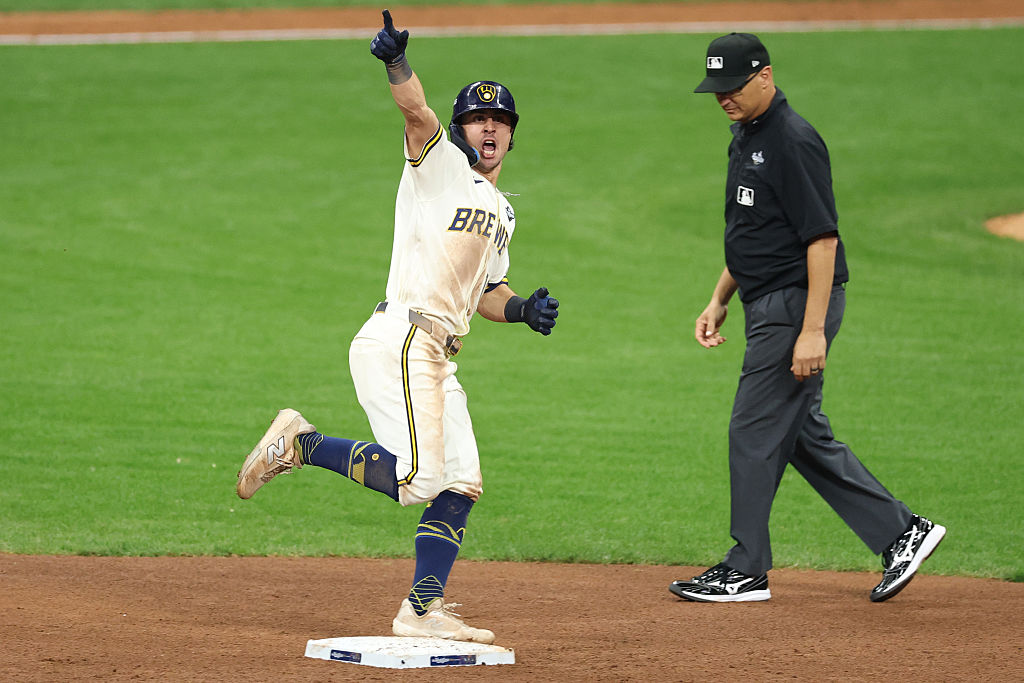
Brewers 5, Rays 4 — 2026 World Series Game Two
MILWAUKEE — Trailing 4–0 in the first inning, the Milwaukee Brewers rallied for five unanswered runs, giving them a come-from-behind 5–4 victory over the Tampa Bay Rays in Game Two of the 2026 World Series Saturday night.
Brewers – Rays Game Summary
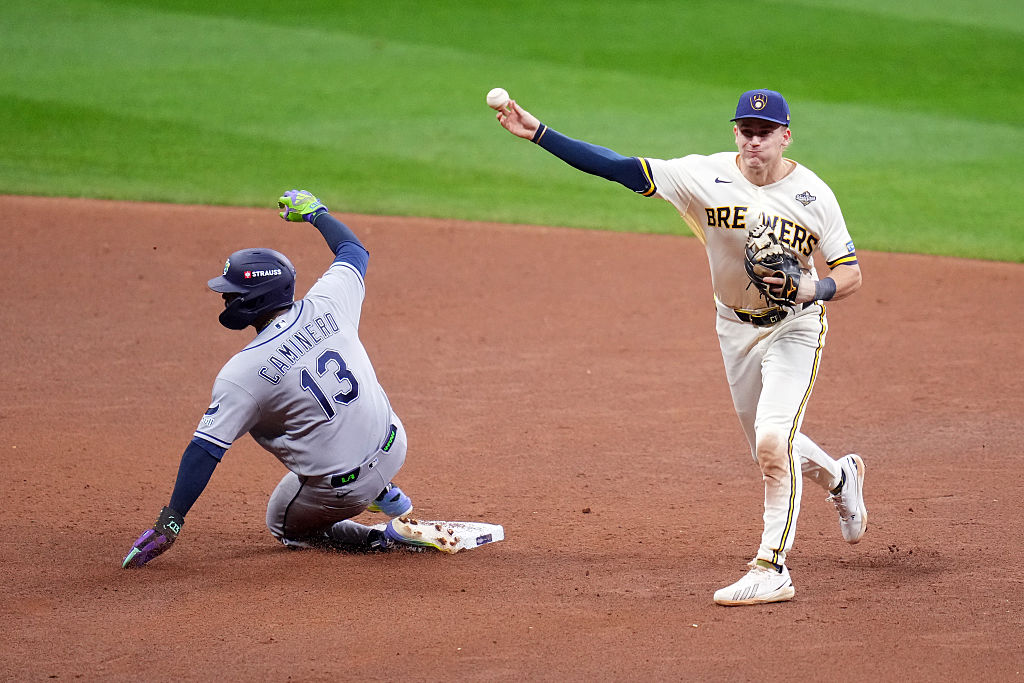
The highest-scoring first inning of a World Series game since 1993 began with an errant throw. Yandy Diaz led off with a slow grounder to short. Cooper Pratt shuffled to his right and had to make a fast, accurate throw. But the throw went wide and out of play, putting Diaz on second after a two-base error. Diaz scored on a one-out single by Chandler Simpson. Simpson stole second before Junior Caminero, up next, drove him home with a single down the left-field line. The 2–0 Rays lead became 4–0 when Liam Hicks, up next, hit a two-run homer to the Rays bullpen in right-center.
In the bottom half, the Brewers answered with two runs on four singles. Jackson Chourio and Jake Bauers led off with consecutive singles to right. A one-out single to center by William Contreras brought in Chourio, and a two-out single by Garrett Mitchell brought in Bauers. When the first inning ended, the score was 4–2 — the most runs in the first inning of a World Series game since Game Four in 1993, the water-logged 15–14 slugfest.
The Brewers cut the lead to 4–3 in the bottom of the fourth after a one-out walk by Pratt. Pratt advanced to third on a single to right by Sal Frelick and scored on a David Hamilton ground ball that went through the legs of Rays first baseman Jonathan Aranda.
In the sixth, Frelick crushed a leadoff homer to center off new pitcher Ian Seymour to tie the game. The homer drew a deafening roar from the standing room-only crowd of 43,245.
Completing the Comeback
Later in the same half-inning, with two outs and Jake Bauers on first, Christian Yelich hit a towering fly ball into shallow left-center. Simpson misjudged it and had to dive to make the catch. He created a divot that resembled a trench for planting corn. Simpson got his glove on it, but like Jonny DeLuca Friday night in Game One, the ball popped out when he hit the ground.
With runners now on the corners and two outs, Tyler Wells relieved Seymour. He got Contreras to bounce to third to escape the jam.
In the seventh, Brice Turang led off with a double. He advanced to third on a fly to right by Mitchell. Up came Pratt, who atoned for his first-inning error with his go-ahead single to right.
The Rays, like Game One, threatened to tie the game in the ninth. Facing the rubber-armed Aaron Ashby, who pitched the last two outs of a 1-2-3 top of the eighth, DeLuca led off with a double. A strikeout and a groundout to second later, DeLuca was on third, 90 feet from tying the game. However, Ashby struck out Diaz to end the game and give the Brewers a 2–0 Series lead.
What Went Right for the Brewers
Resiliency
The biggest story, obviously, is the Brewers fighting out of a 4–0 first-inning hole to win the game. But they could not have done this without holding the Rays scoreless the rest of the way. Furthermore, answering back with an immediate pair of runs in the bottom of the first showed that they would not go down easily.
Redemption
Pratt made a costly throwing error on the first defensive play of the game. Later in the game, he redeemed himself with the go-ahead RBI single.
“Yeah, the game has a way of doing that to you, you know what I mean?” Brewers manager Pat Murphy said. “That speaks to Cooper, what type of individual he is, being able to hang in there when things didn’t go great for him early, even early in that at-bat.” Murphy later called Pratt’s performance a great illustration that the game starting negatively “doesn’t mean it has to end that way.”
Additionally, there were two more slow balls hit to Pratt later in the game by fast runners. Both times, he had to charge and make a quick, hard, accurate throw to get the out. There was a third grounder in the whole that was not hit hard and fast, forcing Pratt to shuffle to his right and wait on it before firing a dart across the diamond. But unlike the first-inning grounder from Diaz, Pratt made accurate throws to retire the batter.
What Went Wrong for the Brewers
Starting Pitching
Logan Henderson threw 29 pitches in a marathon first inning. He ultimately lasted three innings. Henderson allowed four runs, with three of them earned, on three hits, one of which was the Hicks homer. Additionally, all the runs came in the first. Henderson walked one and struck out four.
Early Deficit
No matter how good a team is at comebacks, it is never advisable to fall behind by four runs. To illustrate further, take “Win Expectancy.” After the Hicks home run, the Win Expectancy for the Brewers was 18%. This means that for every game we have record of, when the home team has trailed by four in the top of the first with one out and nobody on, they have come back to win 18% of the time. Scoring two in the bottom of the first increased the Win Expectancy to 30% when the inning ended — still a tall order.
What Went Right for the Rays
Took Early Lead
The Rays were ahead, 4–0, before the Brewers even batted. Especially positive for the Rays is that they punished the errant throw towards first on the opening play.
Did Not Go Quietly
Even after losing the lead and later falling behind, the Rays made Ashby sweat to finish them off. They got the tying run to third, giving Diaz a chance to tie the game or give the Rays the lead.
What Went Wrong for the Rays
Starting Pitching
Drew Rasmussen has had a great postseason in 2026, but he struggled Saturday. He did not survive the fourth, allowing three runs on six hits. Additionally, he walked two and struck out four.
Missed Opportunities
Yes, the Rays took a 4–0 lead, but they failed to tack on. It was not for lack of opportunity, however. Of the six runners the Rays left on base, four were in scoring position. The Rays went 3-for-15 with runners in scoring position. Their first two hits of the evening were with runners in scoring position (RISP), and both produced an RBI. However, after the Hicks homer, they were 1-for-12 with RISP. The only hit of those came on the play where Hicks was gunned down trying to score.
There were three times the Rays advanced a runner to third. However, since he arrived with two outs in each case, it limited their scoring options. With less than two outs, they could score on a hit or on a productive out — namely a sacrifice fly or squeeze play. But with two outs, they had to get a hit, so a squeeze would only work if the batter reached first safely. (Author’s Note: I did not include a bases-loaded walk since each time the Rays had a runner on third, he was the only runner on base.)
Credit obviously goes to the Brewers for escaping each time. Nonetheless, the Rays did not execute, leaving multiple chances on the table.
Thrown Out Trying to Score
In the top of the sixth, on a sharp single to left that wasn’t fielded all that deep, Liam Hicks — the catcher — tried to score from second. Hicks is not a speed demon. Unsurprisingly, he was out at home by a mile.
Rays manager Kevin Cash, however, did not feel it was ill-advised. Their modus operandi all season has been to put pressure on the defense. Cash pointed out that Chourio got rid of the ball quickly and threw it where Contreras could gather it and apply a quick tag. He later explained, “Two outs right there. You know how talented that pitching staff is. How many times are you going to piece together that many singles? Let’s see if we can put some pressure on somebody else. To their (the Brewers) credit, they have responded with everything that we have thrown at them in these first two games.”
Quotes
“These Milwaukee fans have been really loud. I know our fans are going to be really loud and excited to see us come back and reset ourselves. We’ve got a really good pitcher going, as do they. A lot of confidence in this club to respond. They’ve done it all season long, and they’ll continue to do it.” — Rays manager Kevin Cash on his club’s chances in Game Three
“You kind of have to have the opportunity. They changed the pitchers, and Vogey (Brewers hitting coach Daniel Vogelbach) kind of pulled me aside. He said, ‘Hey, you were built for this type of stuff,’ kind of hyping me up. My heart was racing, I’m not going to lie. You saw me chase the 1-1 pitch in the other batter’s box. You try to relax and calm down and breathe and focus. Then good things happen. It was awesome, especially being able to redeem myself for the mess-up in the first. It’s nine innings for a reason. You get four at-bats. You’re going to go back out for defense, and it’s important to remember that, pitch by pitch.” — Cooper Pratt on his go-ahead single and its atonement for his first-inning error
Quick Hit
With the save, Ashby became the third Brewer to ever record a World Series save. He also moved into a tie with Trevor Megill for second place on the all-time Brewers World Series save list. But, of course, there is a caveat. Ashby, when told after the game, responded tongue-in-cheek, “That is certainly a crazy thing. But when you’ve only been (to two World Series ever), it’s probably a little bit easier to do than if you’re with the Dodgers or someone like that.” Megill and Ashby trail Bob McClure, who recorded two in 1982 in lieu of the injured Rollie Fingers.
Looking Ahead
Abner Uribe earned the win as Tyler Wells took the loss, both in relief. Ashby notched the save.
After taking Sunday off to travel from Milwaukee to St. Petersburg, the Brewers and Rays will play Game Three of the 2026 World Series Monday. Lefty Robert Gasser (5–5, 3.87 ERA in regular season) will take the mound for the Brewers, facing Rays righty and former Brewer Freddy Peralta (5–2, 3.25 in regular season with Rays). First pitch from Tropicana Field will be 8 pm Eastern/7 pm Central.
Of note, this will be the park’s first World Series game since 2008. Additionally, with Logan Henderson and Robert Gasser, this will be the third time in World Series history that a team will start rookie pitchers in consecutive games (h/t Elias Sports via Sarah Langs of MLB.com; this excludes “openers”). The last time this happened was 2015, when the New York Mets started Noah Syndergaard and current Ray Steven Matz in Games Three and Four, respectively. Before that, the last time was 1997, when the then-Florida Marlins started Tony Saunders and Livan Hernandez in Games Four and Five, respectively.
More General Baseball Articles
More Milwaukee Brewers Articles
More Tampa Bay Rays Articles
More MLB Articles
Main Photo:
- Categories
-
General Baseball
Milwaukee Brewers
Tampa Bay Rays
- Tags
- 2026 Milwaukee Brewers season
- 2026 Postseason
- 2026 Tampa Bay Rays season
- 2026 World Series
- Aaron Ashby
- Abner Uribe
- Brice Turang
- Chandler Simpson
- Cooper Pratt
- David Hamilton
- Garrett Mitchell
- Jackson Chourio
- Jake Bauers
- Junior Caminero
- Liam Hicks
- Sal Frelick
- Tyler Wells
- William Contreras
- Yandy Diaz